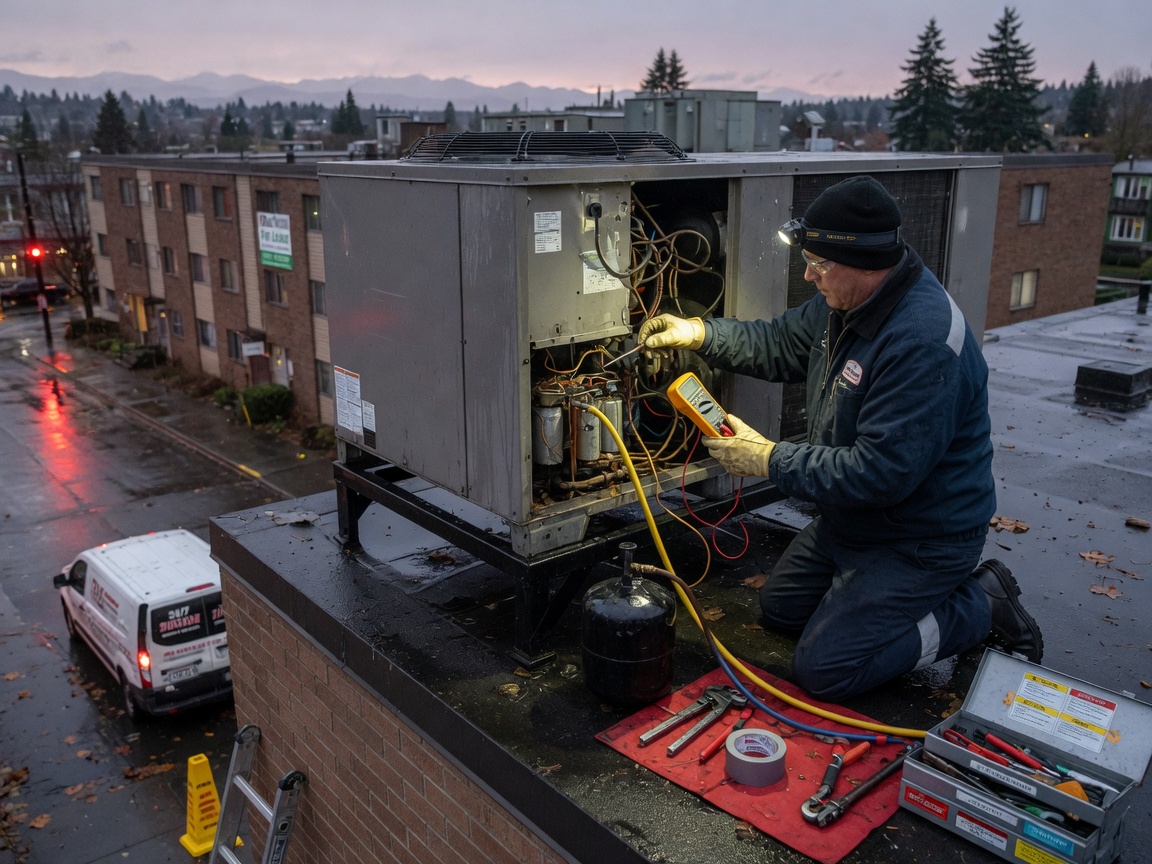
Washington sits in a humid subtropical zone where summer humidity routinely pushes dew points above 70 degrees, forcing air conditioners to run long cycles that stress capacitors, condensate drains, and coils. Homes near Old Washington Historic State Park often date to the early 1900s with original ductwork routed through crawl spaces that collect moisture and restrict airflow. When an emergency call arrives, technicians first check static pressure because blocked returns in these tight attics can freeze the evaporator in under an hour.
Mild winters in Hempstead County still produce enough cold snaps to expose cracked heat exchangers in older furnaces that have never been serviced since installation. The transition from hot, wet summers to occasional freezes creates expansion-contraction stress on copper lines and solder joints, leading to refrigerant leaks that surface only during peak load. Technicians carry nitrogen for pressure testing on site because driving back from Springdale for tools adds hours to the call.
Emergency HVAC Repair Near You — Choose Your City
Every city below has its own local Emergency HVAC Repair page with coverage details.
Power fluctuations common after storms in rural Washington can trip breakers or damage contactors without tripping the main panel. On arrival, the first step is always verifying 240-volt supply at the disconnect before opening the unit, because many homes here still use aluminum wiring that overheats under continuous load. This sequence prevents misdiagnosis and keeps the repair focused on the actual failure point.
Technician insight
In Washington the detail that catches most people out with Emergency HVAC Repair is the combination of high summer humidity and 80-year-old ductwork around Old Washington Historic State Park; homeowners change filters once a year but the restricted returns still freeze coils because the original returns were never sized for modern equipment.
Frozen Coil During July Heat
A Washington home near the historic park lost cooling on a 96-degree day. Restricted return air from original narrow ducts had frozen the coil solid. We thawed the system, enlarged the return opening, and replaced the capacitor to restore full airflow.
Emergency HVAC Repair Services We Offer
✓No Cool Emergency Repair
Rapid diagnosis and fix for complete loss of cooling during peak summer humidity when coils freeze or capacitors fail.
✓Heating Failure Repair
Same-day service for furnaces that stop producing heat during cold fronts that reach Washington from the north.
✓Condensate Drain Clearing
Clearing algae-clogged drains that cause water backup and system shutdown in humid Hempstead County summers.
✓Refrigerant Leak Repair
Locating and sealing leaks in linesets stressed by temperature swings between hot days and mild nights.
✓Thermostat and Control Repair
Replacing failed thermostats or control boards that leave systems running nonstop or not at all.
Emergency HVAC Repair Cost in Arkansas
| Service | Typical Range | What Affects It |
|---|---|---|
| Diagnostic visit | $95–$150 | Waived when repair is completed same day |
| Capacitor replacement | $150–$275 | Common in high-humidity summer calls |
| Condensate drain service | $125–$225 | Includes algae treatment for local conditions |
| Blower motor replacement | $350–$650 | Varies by motor type and access in older homes |
Ranges are typical for Arkansas and confirmed with an exact written quote before any work starts.
How it works
- 1
Phone Triage
Gather symptoms, age of equipment, and location details to bring the right parts from the Springdale shop.
- 2
On-Site Safety Check
Verify power, gas, and carbon monoxide levels before opening any equipment in older Washington homes.
- 3
Root Cause Diagnosis
Measure pressures, temperatures, and airflow to identify whether the issue is electrical, mechanical, or airflow related.
- 4
Repair And Test
Complete the fix, restore operation, and run the system through a full cycle to confirm stability.
Pricing
Upfront written quotes provided after diagnosis; most emergency repairs fall between diagnostic fee and major component replacement.